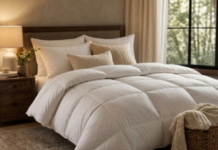

If your sleep is poor and you want to fix the room rather than your schedule, only two things reliably justify attention: the light coming into the room, and the down comforter on the bed. Light decides when sleep ends. The comforter decides whether you stay asleep through the middle of the night. Almost everything else in the bedroom adjusts comfort at the margin.
That is a shorter list than most bedroom guides offer, and deliberately so. Working down a long list in the wrong order is how people spend a lot and change little.
First: light and noise, because they cost almost nothing
The cheapest intervention available is a blackout curtain or a well-fitted blind. Light in the early morning shortens sleep at the end, which is the part people rarely notice losing, and no bedding compensates for a room that gets bright at five.
Noise sits in the same category. If you cannot remove the source, a fan or a steady background sound masks it more effectively than earplugs for most people, because it raises the floor rather than blocking peaks.
Neither of these is a purchase worth agonising over. Fix them, sleep a week, and see what is left. Quite often the remaining problem is thermal — and that is where the second item comes in.
Second: the down comforter, because it sets the ceiling
The down comforter is the single largest thermal decision in the room. Everything else adjusts how the bed feels; this one decides how much heat stays in. If you are waking at three in the morning too warm, or surfacing repeatedly because you are cold, this is the item to address.
Three specifications do the work, and they are independent of one another.
Warmth level should match your bedroom rather than the season on the label. A cool, well-ventilated room tolerates a heavier level than a stuffy one, and most people who think they need a warmer comforter actually need a better-ventilated room.
Shell fabric decides how fast moisture leaves. This is the specification people skip, and it causes the most misdiagnosed problems: if vapour cannot escape, you feel hot at any warmth level, because damp air conducts heat far better than dry air. Silk and linen blends move vapour faster than dense, highly finished cotton.
Shell density matters for a different reason. A tightly woven shell keeps dust mites out of the fill and keeps down inside the comforter, which is why a hypoallergenic goose down comforter should be judged on construction rather than on the word itself. Fill type is rarely the allergen; the barrier around it is what does the work.
Be honest about which of the three you actually need to change. Buying a warmer down comforter when the real issue was a humid microclimate is the most common wasted purchase in this category, and it is easy to make because both problems present the same way at three in the morning.
The specs, in plain terms
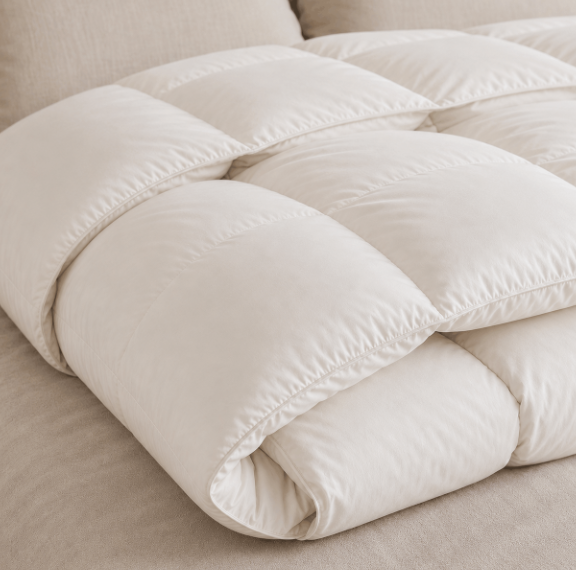
The Warmy Tummy Deluxe Silk Goose Down Comforter pairs a shell of 80% Egyptian cotton and 20% silk with a satin finish, woven in Japan at 600 thread count, with a fill of 90% European goose down at 800 fill power, held in a baffle box with Air-CircuX(TM) airflow channels and anchored by corner loops, certified to the Responsible Down Standard (RDS), OEKO-TEX(R) STANDARD 100 and IDFL, and offered in Light, All Season and Ultra Warm across three sizes — Twin/Twin XL 68″x86″, Full/Queen 90″x90″ and King/Cal King 107″x90″.
Two lines there map onto the checklist directly. The 800 fill power is why this down comforter delivers a given warmth at low weight, which matters if part of your problem is that you find heavy bedding oppressive rather than comforting — not everyone does, and it is worth knowing which camp you are in before spending. The certifications answer separate questions and none of them is a sleep claim: OEKO-TEX(R) STANDARD 100 covers tested substances in the finished textile, the Responsible Down Standard (RDS) covers the sourcing and welfare chain behind the fill, and IDFL is the independent laboratory that verifies down and feather content. Reading those three correctly is more useful than any adjective on a product page.
A silk blend is not the only route to that behaviour, and it is not the cheapest. An open-weave linen blend reaches similar breathability through fabric structure rather than fibre chemistry, so a down comforter with a linen shell delivers much the same moisture performance with a crisper hand and a bit more visible texture. Which of the two you prefer is a matter of what you like against your skin, not of which one works.
Third: the air in the room, which costs nothing at all
Ventilate in the morning rather than making the bed immediately. Overnight your body releases a surprising amount of moisture into the bedding; smoothing everything down at seven seals it in for the day. Ten minutes with the covers thrown back and a window open does more for the microclimate than most purchases.
A basic hygrometer is worth more than most sleep gadgets, because it converts a vague complaint into a number. Moderate humidity is the target — dry enough that vapour moves away from you, not so dry that airways suffer. Once you know that number, you can tell whether the problem is the room or the comforter, which is the distinction this entire list turns on.
When moisture is not actually your problem
Everything above assumes you wake up warm and damp. Plenty of people do not. If you wake because you are cold, or because the bed never feels properly enveloping, breathability is the wrong specification to optimise and you should be reading warmth level and construction instead.
For that case a plain organic cotton sateen shell is the most forgiving choice — familiar to the hand, easy to live with, and less demanding to care for than silk. What matters more there is what is holding the fill in place: a baffle box down comforter with staggered chambers keeps the down spread evenly instead of drifting toward the edges, and even coverage is what stops the cold spots that make a warm comforter feel inadequate.
None of the three shells is better in the abstract. They are different answers to the question of how your body loses heat and moisture, and the honest way to choose is to work out which of those two is failing you before you spend anything.
Where this list is wrong for you
If you fall asleep easily and wake unrefreshed, the room may not be the issue at all — that pattern points more often to sleep quality problems than to bedding. If you wake at a consistent hour every night with your mind racing, the same. And if you have run this list and nothing changed, the next step is a conversation with a doctor, not another purchase.
Bedding solves thermal and physical discomfort well. It does not solve much else, and a good product page should not pretend otherwise — including the page for the Warmy Tummy Deluxe Silk Goose Down Comforter, which will help a warm, damp sleeper considerably and will do nothing at all for a racing mind.
FAQ
What should I upgrade first to sleep better?
Light control, then the down comforter. Blackout curtains stop early-morning light from cutting sleep short, which no bedding can compensate for, and they cost very little. After that, the comforter is the largest thermal decision in the room, and thermal discomfort is the most common cause of waking in the middle of the night rather than at the end.
Is a silk down comforter worth it?
It depends which problem you have. A silk-blend shell moves moisture faster than dense cotton finishes, so it helps people who wake warm and damp, and high fill power keeps weight low for anyone who dislikes heavy bedding. If you sleep cold and prefer the reassuring weight of a substantial comforter, a lower fill power in a cotton shell serves you better.
Why am I still hot after buying a lighter down comforter?
Because you changed the warmth level when the problem was the shell. If moisture cannot pass through the fabric, trapped vapour makes the bed feel hot at any level of insulation, and reducing the fill simply makes you cold and damp instead of warm and damp. Look at the shell composition, and ventilate the room in the morning.